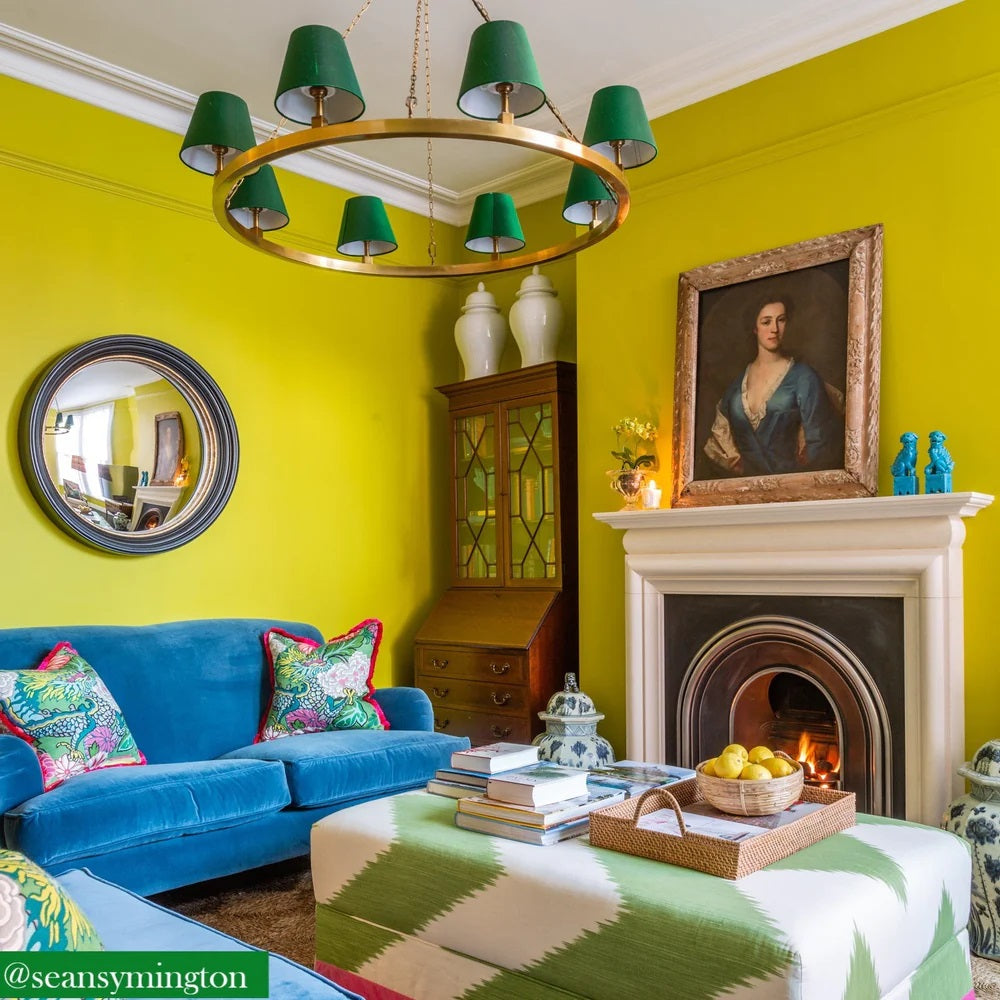
Traditional, but never too serious. Colourful, collected and full of character. Interior designer Sean Symington has a knack for creating rooms that feel as though they’ve evolved over decades, rather than been decorated all at once.
Originally from Toronto, Sean studied Interior Design before working with design firms across Toronto, North America and the UK, eventually establishing his own firm. Today, his interiors are known for their joyful mix of colour, pattern, antiques and contemporary details, all underpinned by a firm belief that a home should reflect the people who actually live there.
We caught up with Sean to talk about where he finds inspiration, the decorating mistakes he sees most often, how to build a room around something you love and, naturally, his interior design lighting tips for making a space feel warm, flattering and full of personality.
How would you describe your interior design style?
I’d describe our style as traditional with a fresh whimsy. It’s definitely rooted in traditional interior design, but we love to add colour, mix in contemporary detailing and not take ourselves too seriously.
We love antiques and an eclectic mix of eras. The twills, the frills, the pops of colour. I think our interiors sit particularly well in traditional buildings, like listed properties, where we can be more adventurous with colour, scale, proportion and pattern.
Our interiors need to be a direct reflection of the people who live there, so they’re deeply personal. I want people to feel energised by their spaces but also cocooned. Warm and welcomed, as though the room has been there for a thousand years and doesn’t feel “decorated”. Youthful and fun, too.

Camden apartment by Sean Symington (image credit), including Pooky's Rattle cane table lamps.
How do you create a home that feels personal?
We find inspiration everywhere, from travel to everything around us. To make sure a space feels individual, we incorporate our clients’ own pieces as much as possible.
We’ll always opt to reupholster or reimagine where we can rather than buying new. Books, artwork, perhaps reframing a cherished painting that belongs to our client. Including as much of their personal belongings as possible is what makes a home deeply personal.
We also avoid designing interiors that feel too perfect. We might not love the lamp base a client already owns, but adding a new Pooky shade brings it new life and makes it feel like it’s been there for years, rather than everything having been bought at once.
I think what really defines a Sean Symington interior is being more adventurous with pattern and scale. Our cushions are often larger than most and we love a big chunky lamp base with a big brown chest of drawers. And, again, just not taking ourselves too seriously.
Is there a difference between designing homes in the UK and the US?
I would say no. US interiors often prefer fresher fabrics. Less tea-stained, with more contrast in materials and colour, fresher overall.
That said, we have a design philosophy we like to follow and it doesn’t matter if it’s east versus west. We simply follow our house style.
Where should you start when designing a room?
We’re frequently asked what the formula is. I’m constantly asked where to start and I think people often overthink colours.
I look at the big picture rather than the details, so start with something you love as a jumping-off point, whether it’s a piece of art or a beautiful rug, and pull the colours from that. If you see something you love, use it as the inspiration to draw your colour palette from.
A lot of people start with the paint colour in a room, and when that happens it often makes things more difficult than looking at the big picture. You need an amazing hero print fabric, perhaps as a cushion or an ottoman, that features the paint colour you might choose, to bring it all together.
Don’t let the fear of getting it wrong stop you
Pulling the scheme together and getting it over the line to finish the project is the biggest struggle. Sometimes things don’t speak to each other, they don’t relate and aren’t linked, and that’s why it’s great working with a designer who can get it over the line and pull it all together.
As for mistakes, I think people overthink a lot and become stunted by decision making. There’s a fear of making a mistake that will cost a lot of money, so in turn they either don’t do anything or over-neutralise everything.
Start your scheme with what you love. Be bold and daring. If you love something, roll with it.


Camden apartment by Sean Symington (image credit), featuring Pooky's Stella pendant (top) and Nellie table lamp in green
Where should you spend and where can you save when decorating?
I think you should invest in good window treatments and upholstery fabrics but save on antiques, like a bamboo side table or a brown chest of drawers.
Save on accessories and furniture but invest in the bones of the room. To make a home feel personal, collect what you truly love. Start with artwork. Buy a painting you love or a beautiful fabric you love.
The architecture of the house also plays a role in dictating the aesthetic. A London home might be more contemporary and the landscape matters too. Is it a beach house or do you have a view of rolling hills? That plays a huge influence, alongside the client’s own aesthetic, in shaping a scheme.
Sean’s interior design lighting tips for a warm and welcoming home
Lighting is never an afterthought in Sean’s projects. His approach to interior lighting design starts with a considered lighting plan combining architectural and decorative lighting, with different sources doing different jobs throughout the day.
“We always do lighting plans and we use a combination of architectural and decorative lighting. For us, what’s key is that lighting is warm and flattering.”
Sean isn’t a huge fan of relying on overhead lighting. Instead, one of his most important home lighting tips is to think about a room at three different heights.
Layer your lighting at different levels
“In any room you do need a combination of high, mid and low level lighting. High level for the ceilings, mid level would be wall lights and low level is table lamps and floor washers."
“We love low level lighting because we think it’s the most flattering. We love it on your face rather than above.”
The result is a room with more depth, atmosphere and flexibility than one relying on a single central light or rows of spotlights. Layering ceiling, wall and table lighting also gives you far more control over how the room feels as the day changes.
Think about what your lighting actually needs to do
Of course, beautiful lighting still needs to earn its keep.
“It always comes back to the purpose of the lighting. Is it mood lighting, task lighting, ambient lighting or practical lighting?”
In a kitchen, Sean points out, you need task lighting and plenty of overhead light so you can see what you’re doing.
His living room lighting tips take a softer approach. Sitting rooms and bedrooms need reading lights and gentler sources that create warmth and atmosphere rather than relying too heavily on overhead lighting.
Don’t hide your lighting. Make something of it.
Where does Sean think people go wrong?
“We’re a bit purist when it comes to lighting. We don’t love concealed lighting and we’re not big on LED strip lights and things like that. Our approach is if it’s a lamp, let it be a lamp.”
Hear, hear.
Rather than hiding light sources, Sean uses decorative lighting as another opportunity to introduce colour, pattern, shape and character.
“We’d always choose a flush mount or a chandelier over recessed spotlights, because we love to make a feature out of the lighting.”
That could mean an oversized table lamp on an antique chest, a colourful lampshade giving an old base a completely new personality, or a pair of wall lights bringing interest to a previously forgotten corner.
Why does Sean use Pooky lighting?
For Sean, a big part of Pooky’s appeal is freedom. Lighting doesn’t always have to be permanently fixed in one place, and a room doesn’t have to remain exactly as it was on day one.
“The other thing we always come back to is having options. At different times of day you may want a much brighter room and in the evening you might want it moodier, so building in that flexibility is essential, which is why we do lighting plans on every project.”
It’s also why portable and rechargeable lighting has become such a useful part of his toolkit.
“The range is fantastic. It’s great that you can bring lighting outside, that you can move lamps around as a room evolves and its purpose changes, and that you don’t have to wire in picture lights because there are rechargeable picture lights and wall light options."
“That freedom and flexibility in lighting is really wonderful.”
 Pooky's Nellie table lamp in green, as styled by Sean Symington (image credit).
Sean’s golden rule? Start with what you love
There’s no magic formula for creating a characterful home, and perhaps that’s the point. Sean’s interiors aren’t built around making everything match or following a prescribed trend. They’re about collecting pieces you love, embracing colour and pattern, making room for things with a little history and allowing a space to evolve with the people who live there.
So, if you’ve been staring at paint swatches for weeks waiting for certainty to strike, put them down for a moment.
Find the painting. Choose the rug. Fall for the ridiculous fabric. Keep Granny’s slightly questionable lamp and give it a fabulous new shade.
Start with something you love and build from there.
Explore Pooky lighting to find lamps, shades, wall lights and plenty more pieces worth building a room around. predictable, budgeted schedule.