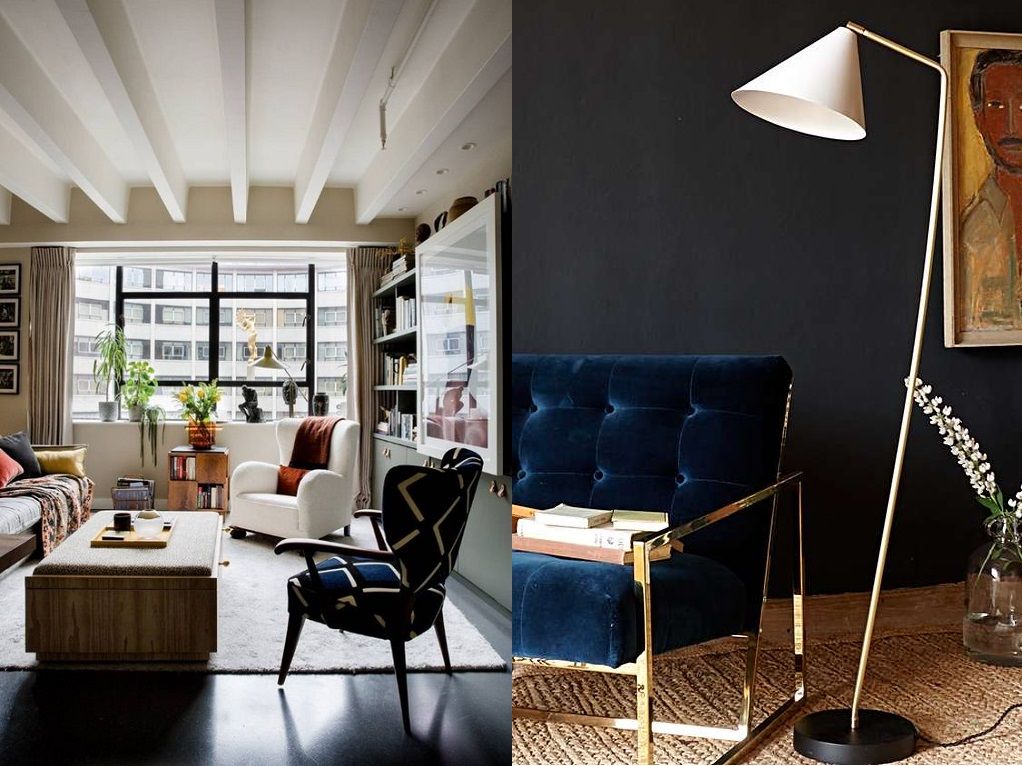
Mid-Century Modern is a design style rooted in clean lines, natural materials, and function-first furniture that first took hold in the mid-20th century and still feels rather fresh today. Getting the look right in your own home comes down largely to lighting, think sculptural pendants, hooded floor lamps, and simple brass wall lights that finish a room properly.
We’re taking a look at some classics and featuring some mid-century modern lighting ideas to give your home that extra touch of style. This is the first in our series on classic interior design styles and how to light them, where we're exploring what defines each trend and sharing lighting ideas (with Pooky examples) to help you bring a touch of it home. First up: Mid-Century Modern, a trend that never seems to die.
 Apartment in Bermondsey - @themodernhouse
When exactly was the ‘Mid-Century’?
Mid-Century Modern generally spans 1933 to 1965, though some designers narrow it to just one post-war decade, 1947 to 1957. It's not the first style to bloom out of postwar confidence either, Regency did much the same a century earlier, channelling a similar optimism into new materials and curved, statement-making design. Rather than getting hung up on exact dates, it helps to focus on the style's defining features: function over ornament, organic influences, natural materials, neutral tones, clean lines, and genuine craftsmanship.
It grew out of early 20th century Modernism and design movements such as that pioneered by the Bauhaus, but embraced the new materials and technologies that were a feature of the post WWII years. Formica table anyone? If you're keen on Scandinavian design, or you've spent any time admiring the sets of Mad Men, you'll already recognise the look.
Furnishing the Mid-Century Modern home
Who are the key designers of Mid-Century Modern furniture?
The giants of Mid-Century Modern furniture design tended to be American (Charles and Ray Eames, for example), Scandinavian (Eero Saarinen)- or Italian (Gio Ponti).
A budget version of Danish designer Arne Jacobsen’s iconic plywood 3017 chair took on an iconic status of its own when, in 1963, at the height of the Profumo affair, photographer, Lewis Morley, used it as a prop during a photo session with Christine Keeler. (Chair, image and contact sheet now in the V&A collection.

Arne Jacobsen chair
Mid-Century Modern furniture in the UK
In the UK, Mid-Century Modern was also influenced by the World War II Utility furniture scheme, which provided essential items for people who had lost their homes in the Blitz. Utility furniture was produced using the slenderest of resources, so simplicity and low cost were of the essence. Several of its designers went on to work for some of the country’s most successful furniture companies of the post-war years. You might be too young to have grown up with Mid-Century Modern design classics, but your parents or grandparents could well have fond memories of Ercol or G Plan furniture.
Then there was Elliotts of Newbury, a company that came to furniture via aviation and brought Danish furniture design to the UK. Not only did these companies produce great designs, their furniture was top quality and built to last. If you’re lucky older family members may still have some of these timeless pieces, many of which are now collectors’ items.
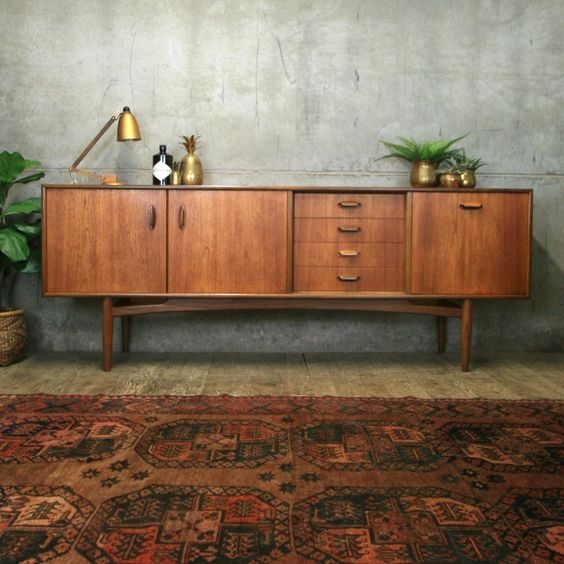 G Plan teak sideboard

Dining chairs by Elliots of Newbury
Where to find genuine Mid-Century Modern furniture today
Even if those family heirlooms have long since disappeared, you can still find pieces at local auction houses, although you might have to be prepared to do some restoration and repairs. If furniture DIY is not your thing, check out small, specialist companies like Grufferty’s for beautifully restored vintage pieces.
Designing the Mid-Century Modern home
Mid-Century Modern architecture and interiors are streamlined, functional, clutter-free, easy on the eye, and easy to maintain, a direct reflection of the same values that shaped its furniture. Nowhere was this new approach to domestic life more in evidence that in the light and airy homes designed by architect Eric Lyons for Span Developments, whose estates sprang up across London and the South East.
 Golden Lane
The City of London’s Golden Lane (1950s) and Barbican (1960s-‘70s) Estates are among the best known examples of Mid-Century Modern architecture in the UK. Designed by Chamberlin, Powell and Bon, the two estates transformed large areas of the City that had been destroyed by bombing during WWII. They are now Grade II listed and display all the confidence and commitment to a better future that is the Mid-Century Modern’s hallmark. The best architecture of the period offers us the same simple, streamlined features that we associate with its furniture. But a lot of thinking goes into creating simplicity…as Mies van der Rohe observed, ‘An interesting plainness is the most difficult and precious thing to achieve.’
Lighting the Mid-Century Modern home
 A sculptural mid-century chandelier
If you are going for the total Mid-Century Modern look, or even a hint of it, in your home, one of the keys to making it work is lighting. This was the era when pendant lights and table and floor lamps really were making an impact and were an integral and essential part of interior design. Here are some tips for introducing a bit of Mid-Century Modern-style lighting, whether you want a complete retro feel or want something a contemporary twist:
1) Get a hood
 A hooded floor lamp in white
The hooded floor lamp or table lamp is a classic Mid-Century Modern look. You don’t have to go the full retro-furniture route to introduce that modernist feel - a floor lamp in the right place will do the trick.
2) Go large on pendants
Large, low-ish pendant shades give the dining room that 1960s style. You can use contemporary materials but keep the look, try a large jute or rattan pendant, which would cast the perfect mellow glow over a vintage teak dining table.
3) Bold colours
 A bold-coloured table lamp
You don’t need only whites and neutrals for a mid-century-inspired scheme – bold and primary colours work well. A bold-coloured table lamp, mustard, terracotta or another statement shade, would fit very comfortably into your Mid-Century Modern sitting room. Pairing a bold base with a contrasting shade in parchment, silk, linen or cotton is an easy way to make the look your own.
4) Simple wall lights
 A simple brass wall light
Brass wall lights in simple, functional shapes are the ticket for a touch of Mid-Century Modern. A simple, unobtrusive brass design will do the job, very cool.
5) Use desk lights liberally
 A mid-century-style desk lamp
The study or office is often the easiest room to go all modernist - a retro desk, armchair, and of course a desk lamp. But you can put mid-century desk lights all over your house for easy, portable mid-century style. And where better to read your back copies of that champion magazine of Mid-Century Modern, Wallpaper* than under a proper desk lamp? So very Sixties!
Let Pooky light up your Mid-Century Modern home. Browse Pooky's lampshades and lighting for pieces to help you set the scene.
FAQs about Mid-Century Modern lighting
What are the defining features of Mid-Century Modern furniture?
Mid-Century Modern furniture is defined by light woods or teak, curved lines, peg legs, and metal frames, a world away from the ornate, dust-collecting intricacy of Victorian and Edwardian design.
How do you light a Mid-Century Modern home?
The quickest way to bring the look home is through five simple moves: a hooded floor or table lamp, an oversized pendant shade, a bold-coloured table lamp, simple brass wall lights, and portable desk lamps used liberally throughout the house.
Is Mid-Century Modern lighting still in style?
Very much so. It's the kind of style that keeps topping interior trend round-ups (Decorilla called it a returning favourite for 2026), and it's easy to see why: the mix of natural materials, sculptural shapes, and function-first design means it sits comfortably alongside more contemporary pieces, which is part of why it never really goes out of fashion.
What's the difference between Mid-Century Modern and Scandinavian style?
Scandinavian style leans on lighter woods like beech, ash, and pine, with a calmer, mostly white and grey palette designed for cosiness through long winters. Mid-Century Modern reaches for richer woods like teak and walnut, and isn't afraid of bolder colours and more angular, geometric shapes. As design writers at Livingetc have pointed out, the two are more similar than people think, both value clean lines and function over fuss, but wood tone and colour are where they really part ways.
How do you mix Mid-Century Modern with other interior styles?
The easiest way is through lighting rather than furniture. A hooded floor lamp or a bold-coloured table lamp can sit happily in an otherwise contemporary or eclectic room, working as a single characterful piece rather than requiring a full styling overhaul. If you fancy going further, our guide to eclectic style has more on mixing periods and pieces with confidence.
What light bulb or colour suits Mid-Century Modern lighting?
Warm light works best for that authentic Mid-Century Modern glow, look for bulbs described as "warm white" rather than "daylight" or "cool white." It's the same warm, golden light you'd expect from an old-fashioned incandescent bulb, and it flatters brass, teak, and those bold accent colours far better than a brighter, bluer light would.